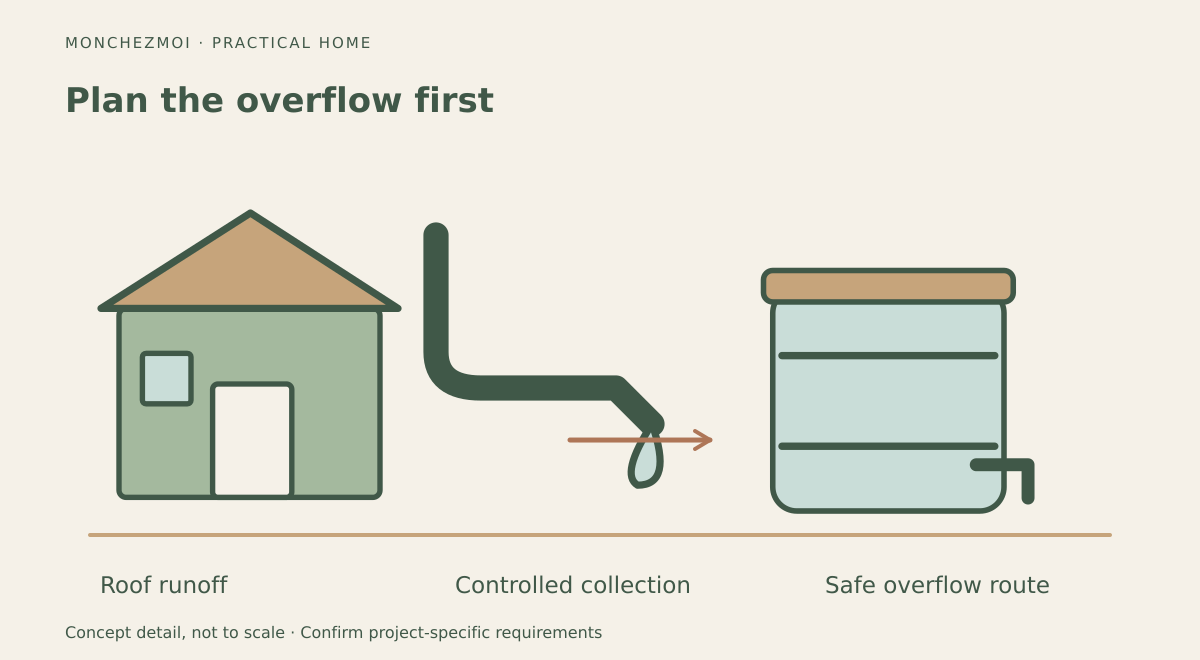
A rain barrel is easy to buy, but a useful rainwater system begins with three questions: how much water can the roof supply, how much does the garden need, and where will excess water go? In Canada, winter shutdown belongs in the plan from the beginning.
Estimate how much rain your roof can collect
One millimetre of rain falling on one square metre of roof represents one litre of water before losses. For a first estimate, multiply the roof area feeding the chosen downspout by rainfall depth and an assumed collection efficiency.
Potential litres = roof catchment area (m²) × rainfall (mm) × efficiency.
For example, 50 m² receiving 10 mm of rain at an illustrative 80% efficiency could yield around 400 L. This is not a guaranteed yield: wind, roof geometry, first-flush diversion, debris and overflow reduce the amount stored. Use the roof area that actually drains to the barrel, not the total house footprint unless the entire roof feeds that outlet.
A common household rain barrel holds about 200 L, according to the Government of Canada. A brief storm may therefore fill a single barrel quickly.
Size storage for the dry periods, not the wettest storm
A smaller barrel close to the beds may be more useful than a larger tank far from the plants. For long dry spells, calculate whether storage meaningfully covers demand rather than assuming rainwater can replace the household supply entirely.
For the related planning task, use our guide to Prevent Soil Erosion Around Downspouts: Practical Drainage Fixes.
Include the parts that prevent trouble
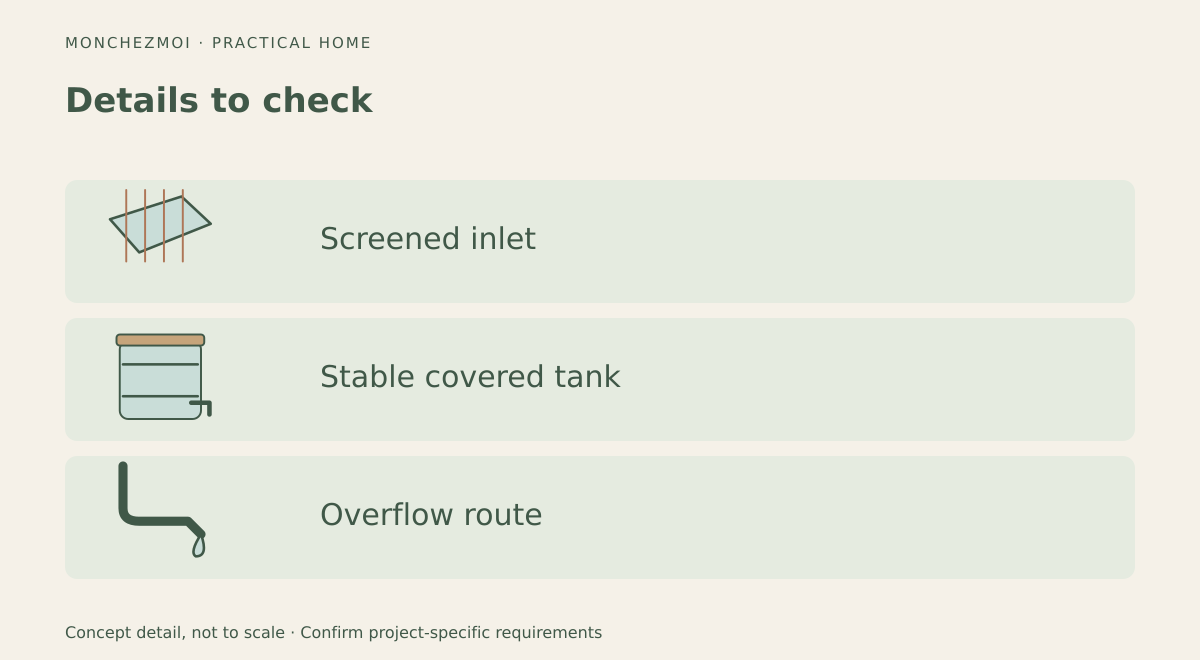
A practical system uses a downspout diverter, a screened inlet, an opaque covered container, a tap and a planned overflow. Screening helps keep leaves and mosquitoes out; a cover also reduces debris and accidental access. A first-flush device can divert some initial roof runoff, but it does not make untreated water potable.
The overflow must handle water when the tank is full. Route it to an approved, well-drained location away from the foundation and neighbouring properties. Check municipal rules before directing runoff into a drain or onto a hard surface.
Multiple barrels can be linked, but their connecting fittings, relative heights and overflow capacity must be planned together. A second barrel does not solve an undersized overflow pipe.
Gravity feed or pump?
Gravity feed is quiet and simple, but its pressure is modest. Raising the water level by one metre provides only about 10 kPa of static pressure before hose losses. That is usually unsuitable for a conventional lawn sprinkler. Some low-pressure watering devices may work, but check their stated operating range.
A pump makes longer hose runs and certain irrigation systems possible. It adds electrical safety requirements, filtration needs, noise, maintenance and winterization. Choose a pump and any outdoor electrical installation suitable for the intended environment.
For the related planning task, use our guide to Où installer une remise pour éviter les problèmes de drainage.
Is roof water safe for vegetables?
For the lowest-risk use, prioritize ornamental plants. If using harvested water around edible crops, avoid wetting the edible portions, particularly leafy greens and produce eaten raw; use a suitable soil-level method and follow current local public-health guidance. Do not use runoff from a roof with suspected hazardous coatings or contamination.
Design for a Canadian winter
Choose a diverter that can bypass the barrel when it is disconnected. Before freezing weather, drain the tank, fittings, filters and any pump as directed by the manufacturer. Restore a safe route for downspout discharge so meltwater does not collect beside the foundation.
Some Québec municipalities offer discounted rain barrels or have local runoff requirements. Verify current programs and bylaws for the property rather than assuming one province-wide rule.
Key takeaways
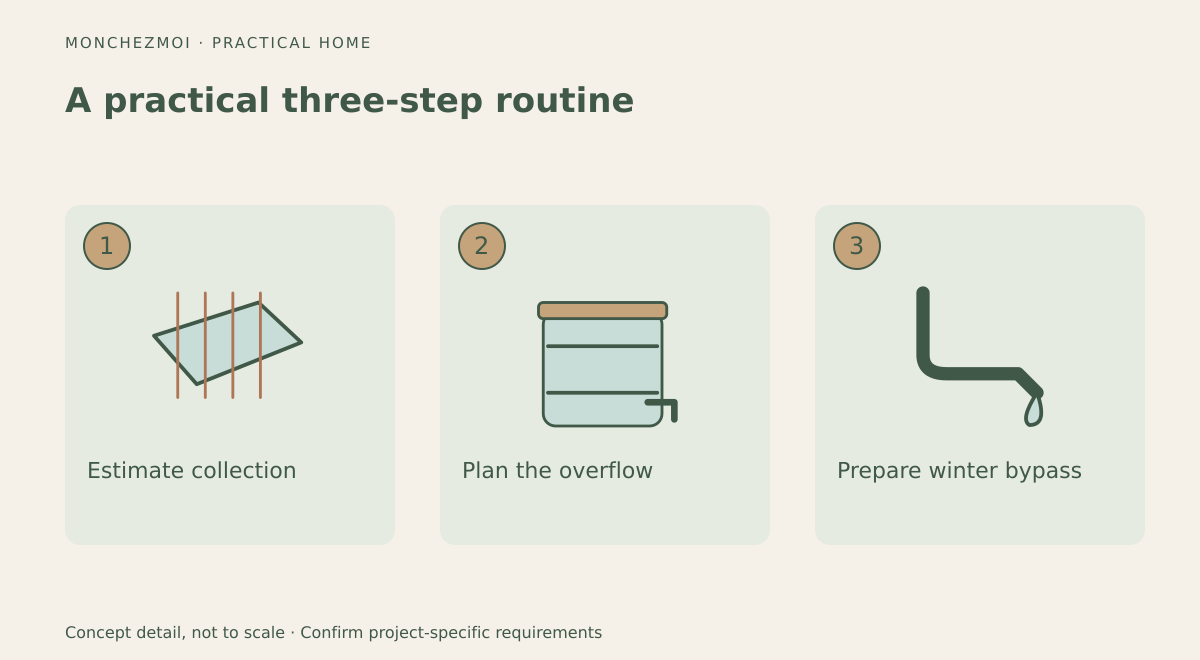
Start with catchment area, irrigation demand and a safe overflow location. Select storage that fits the site, treat roof runoff as non-potable and make winter disconnection part of the original design.