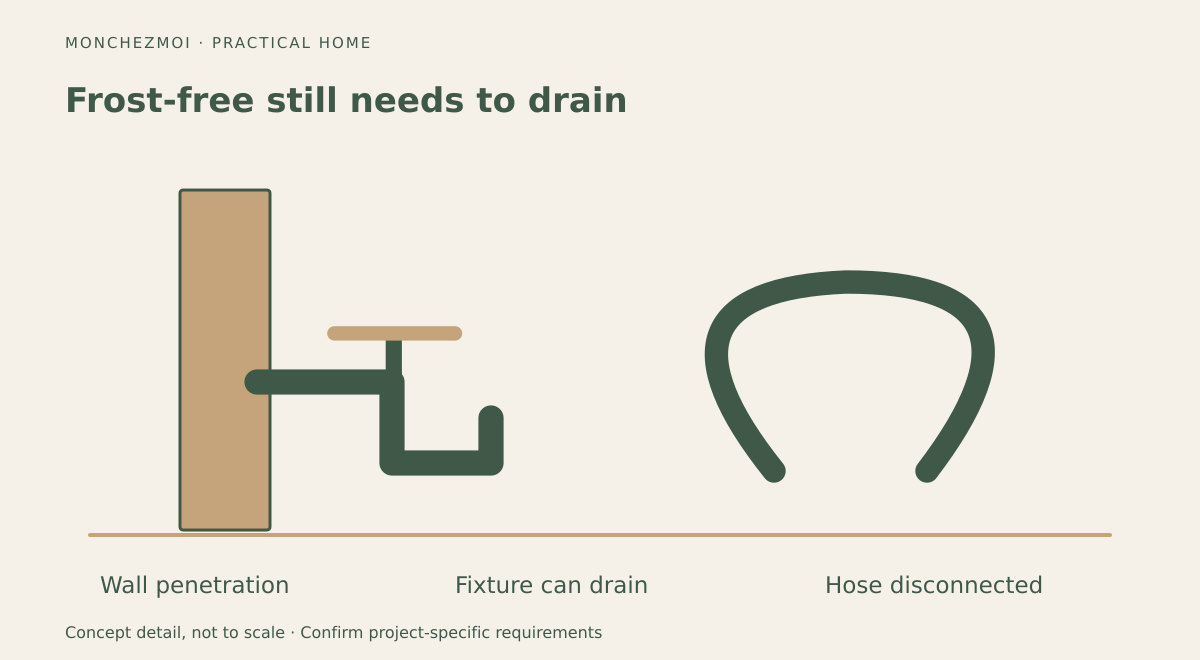
Outdoor plumbing can fail during a cold snap even when the faucet is labelled “frost-free.” The key question is whether water remains trapped in a section exposed to freezing temperatures. Prevention starts with knowing which kind of faucet and supply line the property has.
Identify the faucet before winterizing it
A conventional hose bib usually closes near the outdoor handle. Where an interior shutoff and drain are provided, the seasonal procedure commonly involves shutting off the indoor supply, opening the exterior tap and draining the isolated section. The exact sequence depends on the valve arrangement; consult the installation instructions or a plumber if the system is unclear.
A frost-free sillcock is different. Its shutoff mechanism is set farther inside the assembly, ideally in a protected part of the building. The exterior section must be able to empty when the tap closes. A frost-free label does not mean the entire fixture can hold standing water through winter.
Disconnect the hose and accessories
Remove hoses, splitters, timers and quick-connect fittings before freezing weather. An attached hose can trap water at the outlet and interfere with drainage. Empty and store removable accessories according to their instructions. Inspect hose washers and threaded connections for damage while everything is disconnected.
For the related planning task, use our guide to Where to Install an Outdoor Water Tap for Easy Garden Maintenance.
Why installation angle matters
The Régie du bâtiment du Québec explains that a frost-proof outdoor faucet with an integrated vacuum breaker must be installed with a slight slope toward the exterior so it drains automatically. It also distinguishes models that require an appropriate automatically draining vacuum breaker. This is a technical installation issue, not simply a matter of adding a foam cover.
If the faucet was installed without the required slope, or its internal components are damaged, it may freeze despite being marketed as frost-resistant. A plumber can assess whether repair or replacement is needed.
What insulation can and cannot do
A removable faucet cover may reduce exposure to wind and slow heat loss. Pipe insulation also slows cooling, but insulation does not produce heat. A pipe left in an unheated space can still freeze during prolonged cold weather. Address air leaks, exposed runs and poorly protected wall penetrations rather than relying on a sleeve alone.
For the related planning task, use our guide to How to Winterize Rain Barrels and Outdoor Water Tanks.
Buried garden lines need a separate plan
A year-round underground water line and a seasonal irrigation pipe are not designed the same way. Frost depth varies with local conditions, soil, snow cover and site exposure. There is no safe province-wide burial depth to copy from an online diagram. Have the design checked against applicable local requirements and the specific use of the line.
Seasonal lines should have a reliable way to drain. Low spots, valves and filters may retain water even after the supply is shut off. Automated irrigation systems sometimes require specialist winterization; compressed air should not be used casually.
What to do if a faucet is already frozen
Spring checks matter too
When temperatures rise, reconnect the supply gradually according to the fixture's instructions. Check the interior wall and pipe connections while the exterior tap is operating. Hidden leaks can appear only when the valve is open, particularly if the freeze damaged a section inside the wall.
Key takeaways
Remove hoses, understand the fixture's draining mechanism and address exposed pipes before a cold snap. Frost-free faucets reduce risk only when installed and maintained correctly; insulation alone is not a substitute for draining or a properly protected supply.