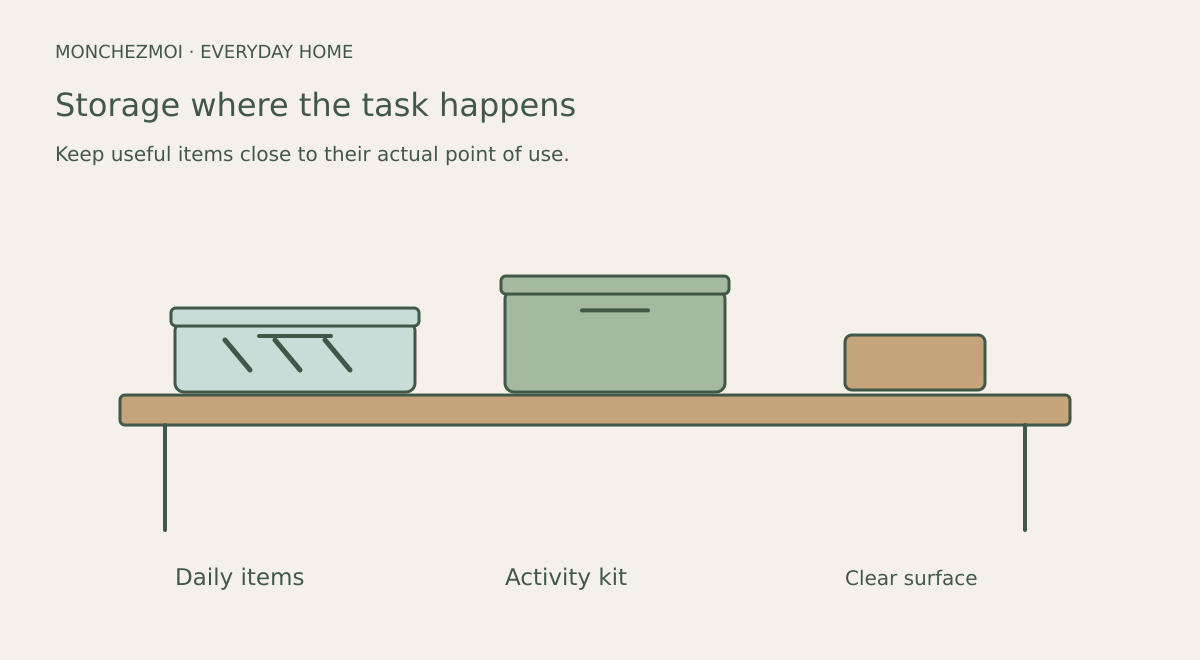
Most Canadian homes store items by room — kitchen tools in the kitchen, office supplies in the office. Yet daily activities rarely respect those boundaries: you reach for scissors in the living room, charge a phone at the kitchen counter, fold laundry on the bed. When items live far from where they’re used, the extra steps to return them become the primary cause of lingering clutter. This guide explains how to map your household’s actual usage patterns, then relocate each item to the zone where the activity happens. The result is a system where putting things away requires almost no effort, so organization sustains itself.
Why activity-based zones work better than room-based storage
Practical examples: keep a pair of scissors in the living room, kitchen, and home office instead of one central drawer; place charging cables at every seating area rather than a single charging station; store mail‑sorting supplies at the entryway where mail arrives. A quick comparison shows the difference: room‑based storage sends you to the kitchen for scissors each time, while point‑of‑use puts them at the nearest spot.
Warnings: duplicate only items used daily in multiple zones — don’t replicate everything. Adding storage without removing the original creates new clutter rather than solving it.
Audit your daily activities to map usage zones
Start by logging every cross-room trip for a week to reveal where items are actually needed. This audit shows your true activity zones so you can place items where they’re used.
Track cross-room trips for one week
Carry a notebook or use your phone to log every time you leave a room to get something. Record the starting room, the item needed, the destination room, and the activity (e.g., "living room → kitchen for scissors → opening package"). After five to seven days, patterns emerge showing your true activity zones.
Identify high-frequency activities and their locations
Common clusters in Canadian homes include the living room for opening packages, trimming threads, and cutting tape; the kitchen counter for charging devices, reading recipes, and sorting mail; and the bedside for reading glasses, phone, medication, and journal.
Note items that migrate and never return
Pay attention to objects that drift from their "official" spot and stay where they were used. These are the strongest candidates for permanent relocation.
Relocate items to their point of use
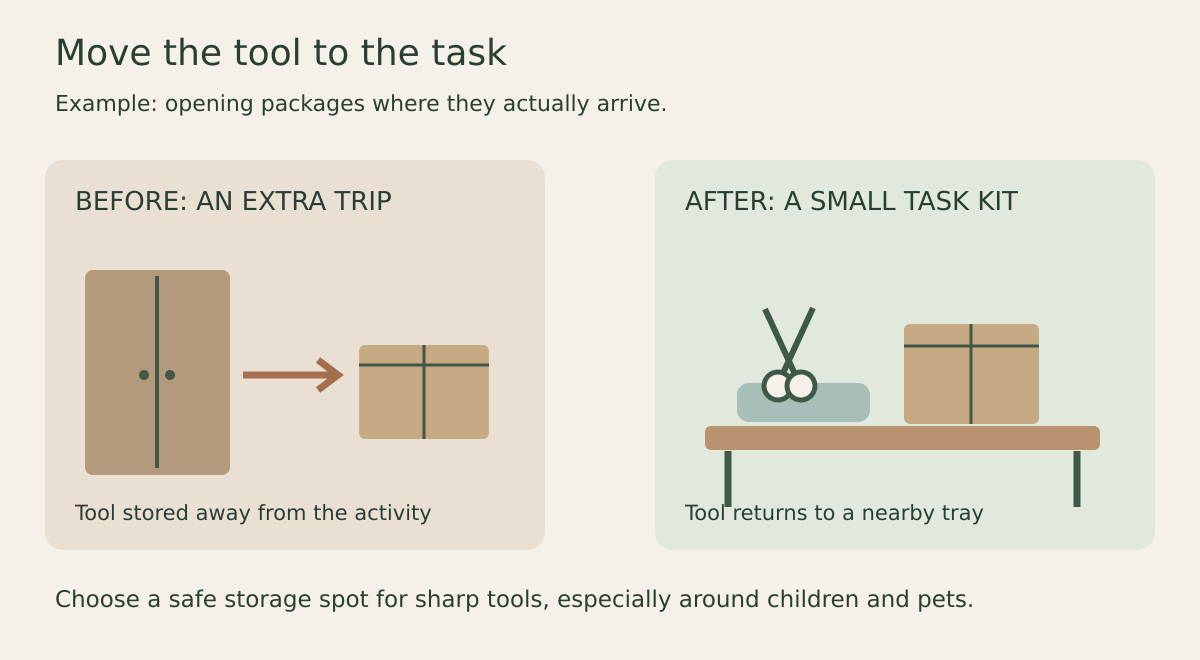
Move each item to the location where the activity happens, not where it “belongs.” Prioritize the highest-frequency cross-room trips and contain each zone so items return effortlessly.
Start with the highest-frequency cross-room trips
Move the item to where the activity happens, not where it "belongs." If you constantly walk from the living room to the kitchen for scissors, keep a pair in the living room. Duplicate only items used daily in multiple zones; a single rarely used tool can stay in its central spot. Professional kitchens organize by functional zones, and the same principle applies at home: group items by how and when the household actually uses them.
Use small containers to keep zones tidy
Contain each zone — loose items become clutter. A basket beside the sofa holds throws, remotes, and charging cables. A small tray on the kitchen counter corrals mail, pens, and reading glasses. A caddy in the bathroom keeps hair ties, clips, and brushes within reach while getting ready. Choose containers that fit the space: a 30 cm × 20 cm tray on the counter, a lidded basket roughly 40 cm × 30 cm × 25 cm beside the seating.
Label until habits form
Temporary labels help everyone learn the new locations. After a few weeks, the system becomes intuitive.
Practical zone examples for common Canadian homes
Below are five common activity zones in Canadian households, each with a compact setup you can adapt to your space.
Entryway launch pad
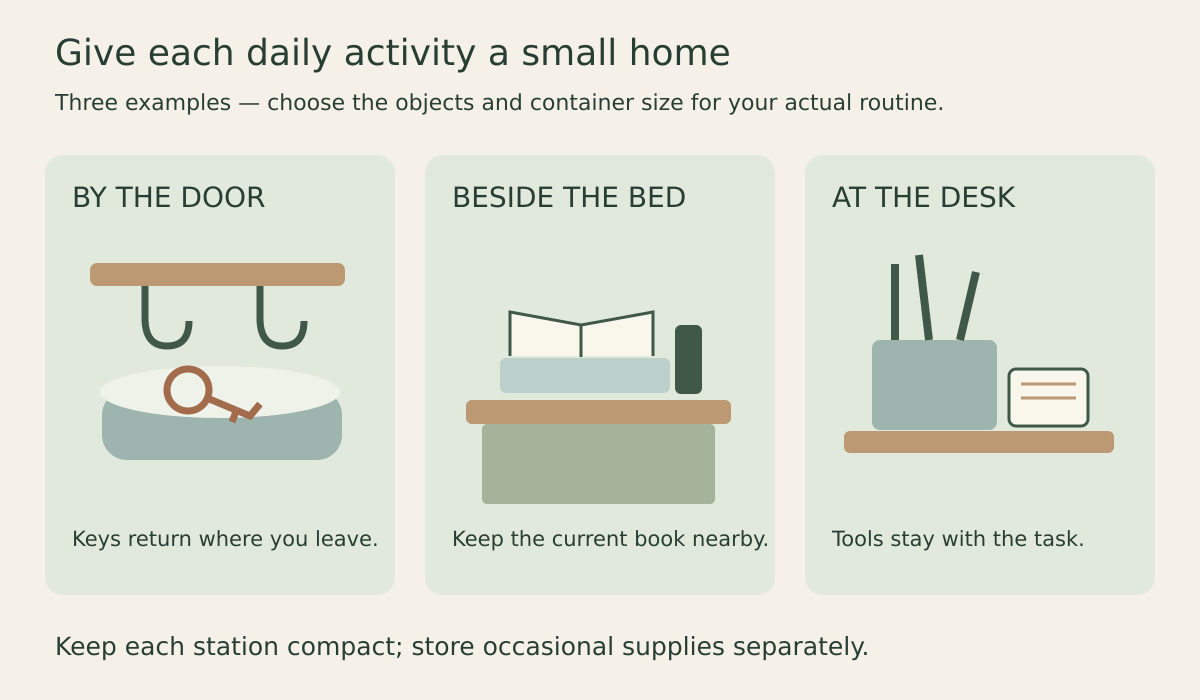
Place keys, bags, shoes, outgoing mail, and the dog leash right at the door — everything that leaves the house with you. A wall-mounted hook strip, a boot tray, and a small bowl for keys keep the zone contained. Renters can use over-door hooks or a freestanding coat rack to avoid wall damage.
Kitchen counter containment
Reserve the counter for daily-use items only: a 30 cm × 20 cm tray corrals mail, pens, and reading glasses. Store less-frequent appliances in cabinets. Vertical space (a wall-mounted basket or pegboard) adds storage without sacrificing prep area.
Living room seating zone
A lidded basket (roughly 40 cm × 30 cm × 25 cm) beside the sofa holds throws, remotes, gaming controllers, and a charging hub. Keeping these at the point of use prevents them from migrating across the room.
Bedside essentials
A small tray on the nightstand holds a lamp, phone charger, water glass, current book, and medications. Everything needed for the wind-down routine stays within arm’s reach.
Home office / homework zone
Pencils, sharpener, calculator, charger, and paper sit in a desktop caddy or shallow drawer insert. When supplies live where the work happens, they return there automatically.
Suggested everyday practices for maintaining point-of-use zones
Countertop containment zones keep frequently used items accessible without consuming the entire surface. A 30 cm × 20 cm tray on the kitchen counter corrals mail, pens, and reading glasses, preventing them from spreading across the workspace. Similarly, placing baskets beside seating and near the TV for throws, remotes, and gadgets reduces surface clutter by keeping items at their point of use. A lidded basket (40 cm × 30 cm × 25 cm) beside the sofa holds two throws, three remotes, and a charging hub, so everything returns to one spot after use.
These are suggested practices based on organizing professionals' experience, not universal rules. Adjust container sizes to your space and household needs. Over-large containers invite overfilling; undersized ones spill onto adjacent surfaces. In compact homes, favour vertical storage such as wall-mounted baskets or pegboards to preserve floor area.
Key takeaways
Organize storage around where activities actually happen, not by room labels. Track cross-room trips for a week to reveal your true usage zones, then move high-frequency items to those points of use. Duplicate only essentials used daily in multiple spots — scissors, chargers, reading glasses — and contain each zone with trays, baskets, or caddies so items return effortlessly. Entryways, kitchen counters, seating areas, bedsides, and workspaces each benefit from a dedicated launch pad. Renters can use tension rods, over-door hooks, and freestanding units; small spaces gain from vertical storage. Review zones quarterly as seasons and life stages shift. These practices draw on organizing professionals' experience, not universal rules.