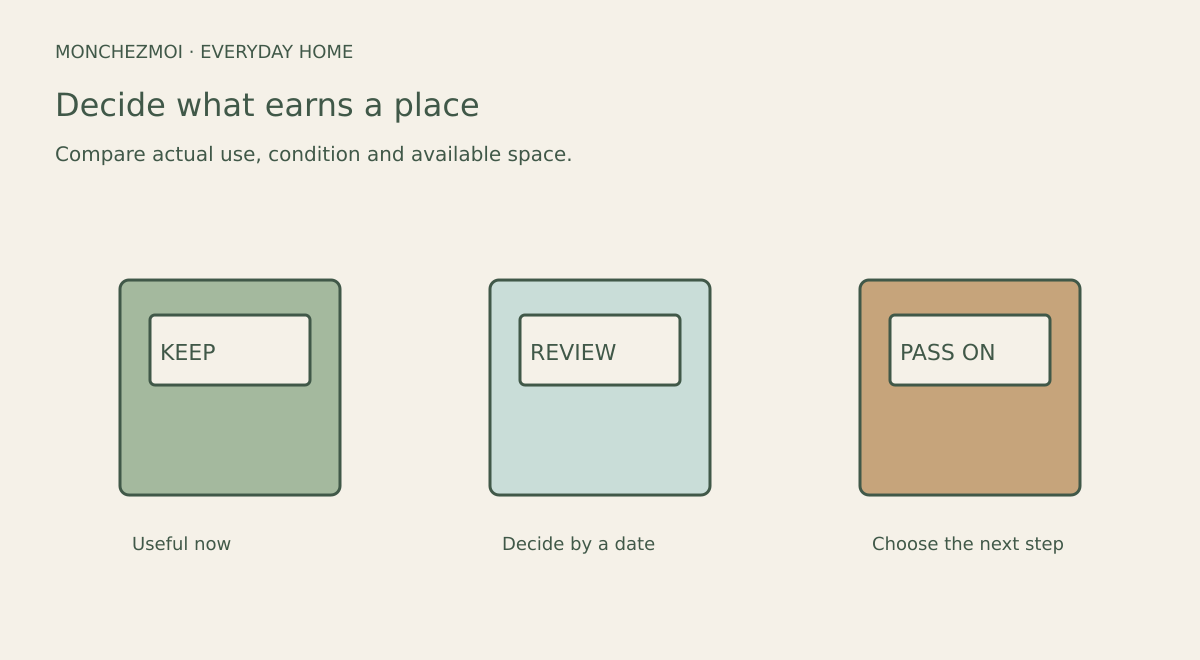
Most decluttering advice relies on vague prompts like "spark joy" or a one-year rule, but those don't measure what an item actually costs in square footage or whether it belongs in daily reach. This framework replaces subjective tests with a repeatable, whole-home audit: keep only what demands daily access in your current living space, assign a fixed spatial budget per category, cap sentimental items in a defined container, and separate genuine seasonal needs from dead weight. The same criteria apply to kitchen gadgets, holiday décor, paperwork, and keepsakes, so decisions stay coherent from the entryway to the basement. You'll evaluate utility, spatial cost, and emotional weight in one pass — no "maybe" piles, no staging areas that become permanent clutter.
Core retention criteria
The first filter is daily access: if an item isn’t needed in your current living space on a daily or near-daily basis, it doesn’t belong in prime storage. Ownership and immediate accessibility are separate — you can own a camping tent without keeping it in the hallway closet. For kitchen counters, see our guide on storing small appliances without cluttering the counter. Next, measure spatial cost: every item pays rent in square feet. Assign a fixed spatial budget per category, such as one archival box per person for keepsakes. High emotional value doesn’t justify unlimited space; cap sentiment with a physical boundary. Utility-first and sentiment-first both have a place, but sentiment gets a defined container, not a blank cheque. Finally, distinguish seasonal necessities from dead weight: keep only what you’ll genuinely use in its next season.
A stand mixer used weekly stays in the kitchen; a fondue set used once in five years moves to seasonal storage or leaves. One banker’s box per family member holds childhood art, letters, and small mementos — when it’s full, something must go before new items enter.
Don’t confuse “might need someday” with “need in current season” — that’s how storage units fill with forgotten boxes. Avoid using “guilt” as a retention criterion; use the memory filter questions instead.
Room-by-room audit process
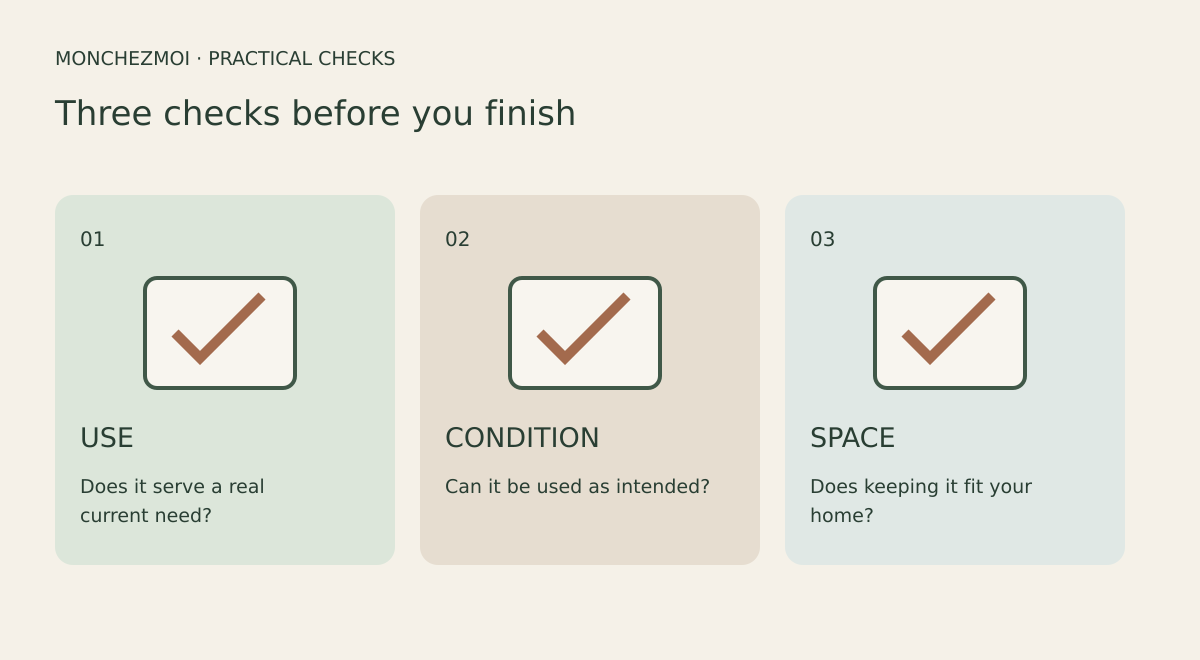
Work one room at a time. In each room, tackle a single zone — a drawer, a shelf, a closet — and pull everything out before making decisions. Sort every item into four piles: daily use, seasonal or occasional use, sentimental keep (bounded by a fixed container), and exit. Apply the daily-access test first: if an item isn’t needed in the current living space on a daily or near-daily basis, it moves out of prime storage into seasonal, sentimental, or exit. Record the spatial footprint of each keep pile; if the total exceeds the room’s allocated budget, re‑evaluate.
In the entryway, daily shoes and coats stay; last winter’s boots go to a seasonal bin; race bibs go to the one archival box per person. In the kitchen, daily cookware stays; holiday cookie cutters go to a seasonal bin; grandmother’s rolling pin goes to the archival box only if it fits.
Do not create a “maybe” pile — it becomes a decision‑deferred pile. Every item gets a destination now. Do not audit the whole house in one day; decision fatigue leads to default‑keep.
Zone‑by‑zone keeps you in context: you see the space freed immediately, unlike category‑by‑category which scatters decisions across rooms.
Managing sentimental items with boundaries
Define a fixed physical container for sentimental keeps — one archival box per person, a single shelf, or a designated drawer. When the container is full, something must leave before a new item enters; this forces curation rather than accumulation. Use three questions to separate meaning from obligation: what specific memory does this hold? Why am I keeping it? Would I keep it if no guilt were involved? Digitize flat items such as letters, children’s art, and certificates to preserve memory without physical bulk; keep only irreplaceable originals.
A single 30×40×15 cm archival box can hold a child’s hospital bracelet, first lost tooth, and three favourite drawings — the rest are photographed and recycled. For a grandmother’s teacup set, keep one cup for display or use; gift or donate the remaining five rather than boxing all six.
Don’t let “sentimental” become a catch‑all for anything you can’t decide on — apply the three questions rigorously. Avoid storing sentimental items in opaque bins in the basement; if you never see them, they aren’t serving their purpose.
Bounded sentiment versus unbounded: a defined container turns emotion into a curated collection; no boundary turns it into a burden.
Executing removal decisions
For example, three bags of clothing can be sorted immediately: one to a donation bin today, one to a consignment shop tomorrow (booked now), and one to textile recycling this weekend. Old electronics should be wiped of data and dropped at a municipal e-waste depot on the way to work — not left in a box labelled "e-waste" for six months.
A "to sell" pile only works if you list the items within 48 hours; otherwise donate them and reclaim the space. Don't let family members "rescue" items from the exit pile — the decision is made. Prompt exit versus staging area: staging feels productive but rarely clears; prompt exit turns decisions into reclaimed space.
Seasonal vs. permanent retention
Keep only seasonal items you’ll genuinely use in their next window. Test each piece with two questions: “Did I use this last season? Will I use it next season?” If the answer is no for two consecutive cycles, move it to the exit pile. Store seasonal gear in labelled, stackable bins in low-access areas — high shelves, basement, under-bed — not in daily-use zones such as kitchen pantries or entryway closets. For pantry organization in tight spaces, see cooking without a pantry. A calendar reminder at each changeover forces the review; when a bin sits untouched for two rotations, its contents leave the home.
For winter, keep one heavy parka, one pair of boots, and one set of ski gear if you ski annually; donate the second parka and worn-out mittens. Holiday decor fits in one bin per holiday; ornaments unpacked only once in two years exit. Avoid “just in case” duplicates — three snow shovels for a single driveway inflate spatial cost without adding utility.
Rotation moves items between active and inactive storage; retention decides whether they stay in the home at all. Prime storage belongs to daily essentials; seasonal items pay rent only in designated low-access space.
Key takeaways
Use daily access as the primary filter: items needed day-to-day earn prime storage; everything else moves to seasonal, a bounded sentimental container, or the exit pile. Assign fixed spatial limits — one archival box per person for keepsakes, labelled bins for seasonal gear in low-access areas — so sentiment and occasional use don't expand unchecked. Audit room by zone, sorting into four piles with no "maybe" category, and measure each keep pile against its allocated budget. When the sentimental box is full, curate before adding; apply the three memory questions to separate meaning from obligation. Once an item is designated for removal, get it out the door the same day — donation, consignment, recycling, or trash — because staging areas become new clutter. Review seasonal bins at each changeover; if unused for two cycles, let them go.