Hardwood, tile, and laminate floors turn into slip hazards once a cat develops arthritis or reduced mobility. Without secure footing, senior cats may avoid the litter box, struggle at mealtimes, or injure their paws on curled rug edges. This guide outlines practical, non‑damaging ways to add traction along the daily routes your aging cat travels — between bed, litter box, and feeding station — while keeping the home safe for human residents. Solutions include low‑profile runners that stay flat, stable mats at key stations, rug pads that protect hardwood, and heavy ceramic or stainless‑steel bowls that resist sliding on tile. Each recommendation is chosen to support mobility without creating new tripping risks.
Why flat, stable mats matter at key stations
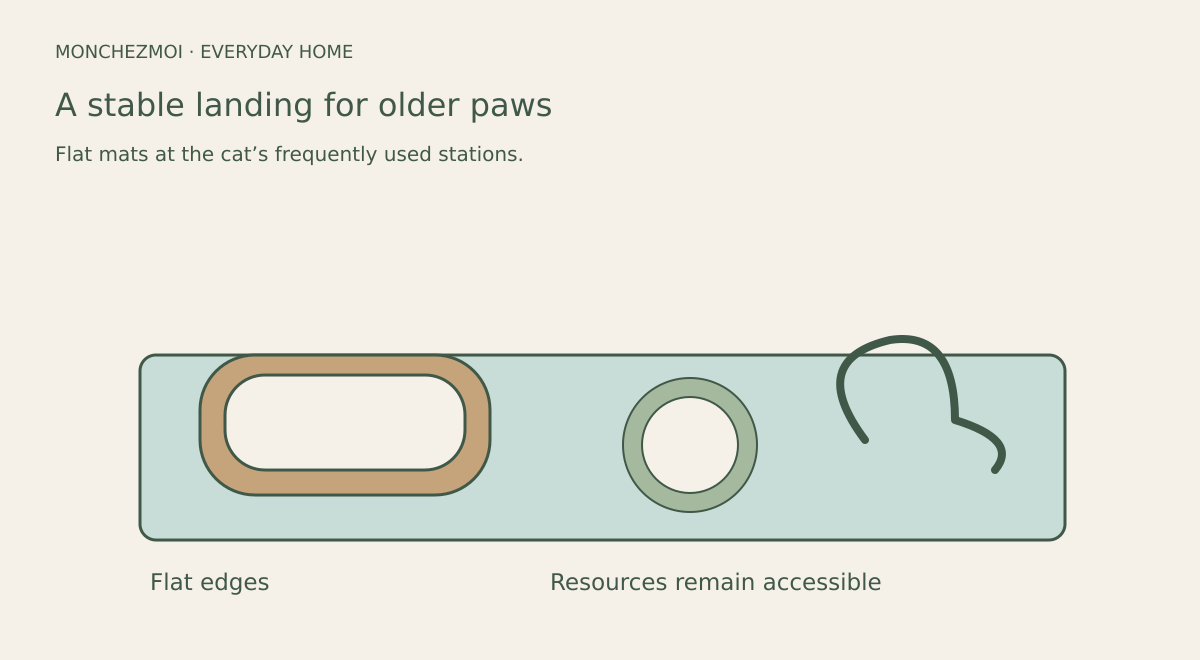
Practical examples include a low-profile runner from the bedroom to the litter box, a flat mat at the litter box entrance large enough for the cat to step fully onto it, and a flat non-slip mat under food and water bowls that does not slide under the cat's weight.
Securing rugs on hardwood without damage
On hardwood, the simplest way to keep a runner or area rug from sliding is a rug pad designed for wood floors. These pads grip both the rug and the floor without adhesives, so they add traction for a senior cat while protecting the finish. Double‑sided carpet tape is often suggested, but it can leave sticky residue and discolour the wood when removed or over time, creating a repair headache for renters and owners alike.
Choose a low‑profile pad rated for hardwood — typically a felt‑rubber blend or a thin PVC‑free mesh — that stays flat and does not add enough height to become a tripping hazard for people. Cut the pad slightly smaller than the rug, so the edges lie flush. If the rug already has a non‑slip backing, test it first; many factory backings lose grip after washing or with age, and a pad underneath restores stability.
For the cat’s travel routes, a secured low‑profile runner from the bedroom to the litter box or feeding station gives consistent footing. Check the pad periodically; if it starts to shift or the rug corners curl, replace the pad rather than resorting to tape.
Feeding station traction on tile
Tile floors are especially slippery for a senior cat with arthritis. Lightweight plastic or thin metal bowls can slide several centimetres when the cat leans in to eat, forcing the animal to chase the bowl or splay its paws to maintain balance. This increases the risk of spills and joint strain. Choose heavy ceramic or stainless‑steel bowls; their mass keeps them in place even when the cat pushes against the rim. Pair the bowls with a flat, low‑profile non‑slip mat that lies flush to the floor and does not shift under the cat’s paws. A rubber‑backed mat or a thin PVC‑free mesh pad cut to the feeding‑station footprint works well. Ensure the mat has no curled edges — curled corners catch claws and defeat the purpose. Test the combination by pressing down on the bowl; if the mat slides, replace it with a higher‑grip version. Regularly inspect the mat’s backing; adhesive‑backed pads can lose grip after cleaning, so a replaceable pad is preferable to a permanent adhesive.
Placement checklist: litter box and feeding area
Litter box: place a flat non-slip mat at the entrance and exit, large enough for the cat to step fully onto it with all four paws. The mat must lie completely flat — no curled corners or bunched edges — because a senior cat’s claws can catch on lifted edges, causing hesitation or injury. Replace any mat that starts to curl.
Feeding area: use heavy ceramic or stainless-steel bowls on a flat non-slip mat that stays in place. Lightweight bowls slide easily on tile, increasing spill risk and forcing the cat to chase them. A rubber-backed mat or thin PVC-free mesh pad cut to the feeding-station footprint works well; test by pressing down on the bowl — if the mat shifts, choose a higher-grip version.
All mats: inspect weekly. Adhesive-backed pads can lose grip after cleaning, so a replaceable pad is preferable to permanent adhesive. Keep the feeding area clear of loose runners that could bunch. The same flat-mat rule applies at the litter box: a stable surface prevents chronic pain and litter avoidance in cats with arthritis.