Most evening mess comes from friction: lids to open, doors to pull, bins that don't match shelves, and no obvious place to land daily items. This guide shows how to redesign those friction points — entryways, hallways, living areas — so the nightly reset becomes a quick, almost automatic flow. The changes are physical (open cubbies, uniform bins, removed doors) and procedural (one basket, one trip), not a new cleaning regimen. By placing open drop zones where people actually enter, standardizing containers that slide straight into shelves, and following a single collection loop, you can return a whole household to order in roughly ten minutes.
Core principle: remove put-away friction
Every extra action — lifting a lid, opening a door, deciding which bin — adds seconds that compound across a household. Design for the "tired hands" moment: open tops, uniform containers that slide straight into shelves, and landing spots at the exact point where items enter the home. Replace a lidded toy bin with an open cube that fits the shelf; toys go in, cube slides back. Swap a coat closet with a door for an open wall of hooks and a shoe cubby at the entry. Traditional systems have items travel room to room, sorted into specific drawers. A frictionless approach uses one basket to collect strays and one trip to return them to open zones. Open storage shows contents; if visual clutter bothers you, use uniform bins in a single colour to keep it calm. Using a single basket to collect out-of-place items during a reset prevents wandering between rooms before final put-away. Removing closet doors creates an open, frictionless drop zone for daily items. Open cubbies with labelled bins allow quick, no-sort put-away for household members.
Create open drop zones at high-traffic entries
Drop zones work best when they sit directly on the path people use to enter the home. The following three entry points — front entryway, kitchen back door, and garage or side entrance — each need open, lidless landing spots for the items that arrive daily. Choose the configuration that matches your layout and traffic flow.
Entryway / mudroom
Kitchen back door
A shallow console with two open baskets underneath works well in a narrow hallway: one for outgoing mail and keys, one for incoming school bags. Plan closed storage first for less‑frequent items, then add open hooks and cubbies for daily use. Hidden storage (cabinets or lidded bins) suits seasonal gear, not the backpack that arrives daily.
Garage / side entrance
Apply the same principle: open cubbies with labelled bins allow quick, no‑sort put‑away. A closed closet with a door requires two actions (open, hang) plus decision fatigue; open hooks and a cubby need one action (hang or drop) and zero decisions.
Standardize bins so they slide into shelves without sorting
Using a single bin format throughout the house eliminates the need to sort items at the drop zone. When every bin shares the same dimensions, any bin can slide into any shelf, and the whole container can be lifted out and carried to its destination room for emptying. Labels on the bins then become the only decision point.
Uniform sizing
Choose one bin format for every drop zone in the house — for example, 13×13×13 inch fabric cubes or 12×16×6 inch clear totes. Consistency means any bin fits any shelf, and the whole bin lifts out when full, travels to its destination room, and empties without item‑by‑item sorting at the drop zone.
Labeling system
Label each bin by category or person (e.g., "Emma — sports", "Mail — action", "Tech — charging"), so the return trip is direct. In the entryway, three labelled cubes on an open shelf might read "Shoes", "Hats/Glove", "Dog Leash"; in the living room, two cubes handle "Remotes/Gaming" and "Blankets".
Shelf depth match
Measure shelf depth before buying; bins that overhang catch on the shelf lip and defeat the slide‑in motion. A 12‑inch deep shelf works with 13‑inch cubes only if the shelf has no front lip — otherwise size down.
Establish a logical flow from traffic paths to storage
A frictionless reset relies on a single loop that follows the household's natural traffic patterns. Map the route each person takes from the entry to the main living spaces, then place drop zones at the natural pause points. The evening reset then becomes a two-pass loop: collect everything into one basket on the way out, and distribute into the labeled bins on the way back.
Map the daily path
Walk the path each person takes from the door to bedroom, kitchen, or living room. Place drop zones at the natural pause points — where shoes come off, bags land, coats shed. In a typical Canadian main floor, that’s the entry bench, the hallway console, the kitchen counter.
One-basket collection
During the evening reset, carry one empty basket. Start at the kitchen sink (or main hub). Sweep surfaces, floors, stairs — everything that isn’t furniture goes in the basket. No sorting, no side trips. The basket is a transport tool, not a storage bin.
Single return trip
Walk the reverse path. Stop at each drop zone and deposit the items that belong there from the basket. One loop, done. For a family of four: basket starts at kitchen counter, collects shoes from living room, backpacks from hallway, coats from entry bench. Reverse loop puts each category into its labelled cubby or bin.
Evening reset routine: 10-minute sequence
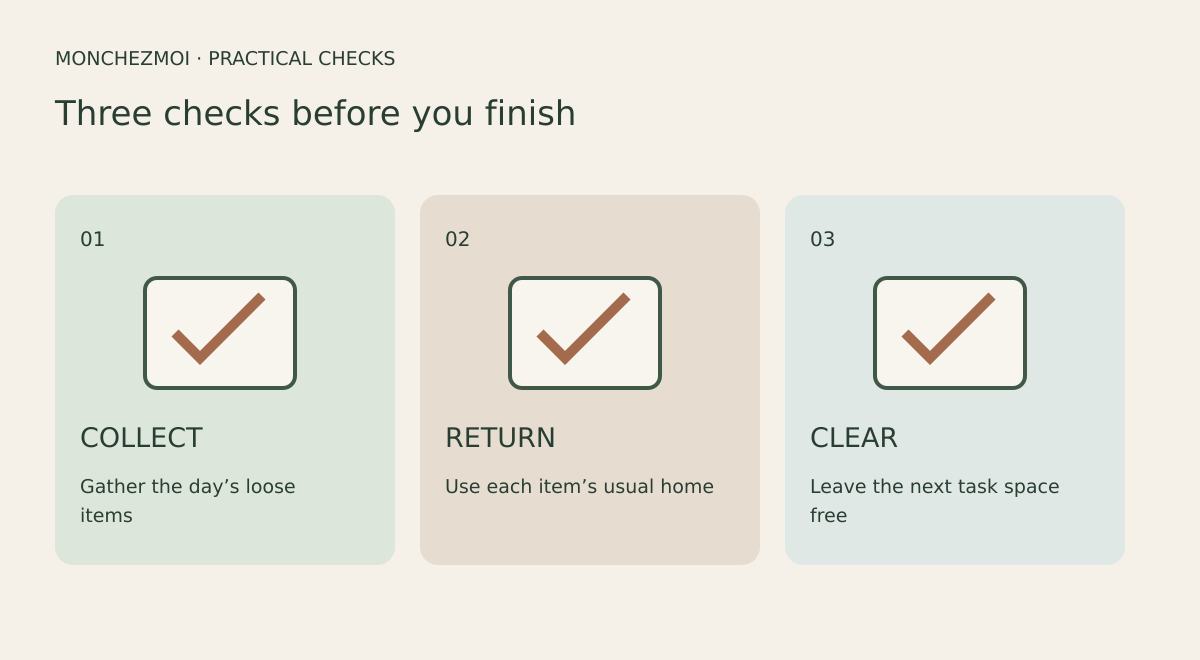
Set a timer for 10 minutes. Start with an empty basket at the kitchen sink or whatever spot functions as your main hub. Move through the main floor in one pass: kitchen counters, dining table, living-room surfaces, stairs, hallway floors. Everything that isn't furniture goes into the basket — no sorting, no side trips.
When the basket is full or the circuit ends, walk the reverse loop you mapped earlier. Stop at each open drop zone and deposit the items that belong there into their labeled bins or cubbies. The bin is the decision; you simply match category to label.
Finish with a quick surface reset: wipe kitchen counters, fluff sofa cushions, straighten the entry bench. When the timer sounds, stop. Anything left in the basket or still out of place waits for tomorrow; the system is sized for daily volume, not perfection.